
How Can You Choose the Right Electric Hoist for a Small Manufacturing Workshop?
September 18, 2026
Choosing the right electric hoist for a small manufacturing workshop starts with the lifting task, not the hoist model. You need to define load weight, lifting height, lifting frequency, available power, installation space, and load movement before comparing equipment. A small workshop may not need a large-capacity industrial electric hoist, but it still needs enough capacity and suitable operating features for daily production. A motorized hoist can improve material handling, reduce manual lifting, and support repeatable workflows when the equipment matches the application.
For example, a workshop that moves 300 kg molds between workstations has different requirements from a metal fabrication shop that regularly handles 2-ton assemblies. The first application may favor a compact chain hoist with simple controls. The second may require higher capacity, a trolley system, stronger duty characteristics, and more precise load positioning. The correct electric lifting hoist should therefore match both today’s workload and the workshop’s expected operating pattern.
ASME B30.16 covers the construction, installation, operation, inspection, testing, and maintenance of overhead underhung and stationary hoists. OSHA also defines rated load as the maximum load for which the manufacturer designs and builds the hoist.
For B2B buyers, this distinction matters because the lowest purchase price does not always represent the most suitable specification. An undersized hoist can restrict production, while unnecessary capacity can increase equipment cost, structural requirements, and installation complexity. The better approach is to evaluate the complete lifting application before selecting the equipment.
1. Define the Workshop’s Actual Lifting Requirements
The first step is to describe what the hoist will do during a normal production day. Start with the loads, then consider how often they move and where they need to go.
A useful specification should include:
- Maximum load weight
- Typical working load
- Lifting height
- Lifting frequency
- Required lifting speed
- Horizontal movement requirements
- Available headroom
- Power supply
- Installation structure
- Operating environment
- Operator position
- Expected future workload
These factors provide a practical starting point for comparing different electric hoist configurations.
Maximum Load Is Only One Part of the Selection
Rated capacity should cover the intended working load without encouraging routine operation at the limit.
Suppose a small machinery workshop normally handles components between 400 kg and 700 kg. The largest planned component weighs 800 kg. Selecting equipment solely around the average 500 kg load would leave little margin for the actual production requirement.
The workshop should instead identify the heaviest intended load and evaluate the complete lifting arrangement.
The load itself may also require additional consideration. A compact steel component may have a different center of gravity from a long fabricated frame. Irregular loads can require different lifting accessories and more careful positioning.
OSHA states that cranes should not exceed their rated load except for permitted testing. It also requires loads to be properly secured and balanced before being lifted more than a few inches.
Measure the Lifting Height
Lifting height affects both equipment selection and installation.
A workshop may need to lift a component from the floor onto a machine bed. Another application may require the hoist to raise material into a storage position.
Measure the required vertical travel rather than estimating it from ceiling height.
The useful measurement should account for:
- Floor-to-load starting height
- Required lifting height
- Hook clearance
- Beam or trolley height
- Hoist body dimensions
- Remaining headroom
A small workshop often has limited ceiling space. A compact chain hoist can therefore make more sense than a larger wire rope configuration when the application allows it.
Calculate the Lifting Frequency
How often the hoist operates can affect the appropriate equipment specification.
Consider the difference between these two workshops.
Workshop A lifts a 600 kg component five times per day.
Workshop B lifts a 600 kg component every three minutes during an eight-hour shift.
Both workshops have the same maximum load. Their operating requirements are not the same.
The second workshop places much greater demand on the lifting mechanism, motor, brake, controls, and other components.
For this reason, B2B buyers should provide the supplier with actual operating information. Saying “1 ton capacity” gives only part of the picture.
2. Choose the Right Hoist Capacity and Configuration
Once the application is defined, compare capacity and equipment configuration.
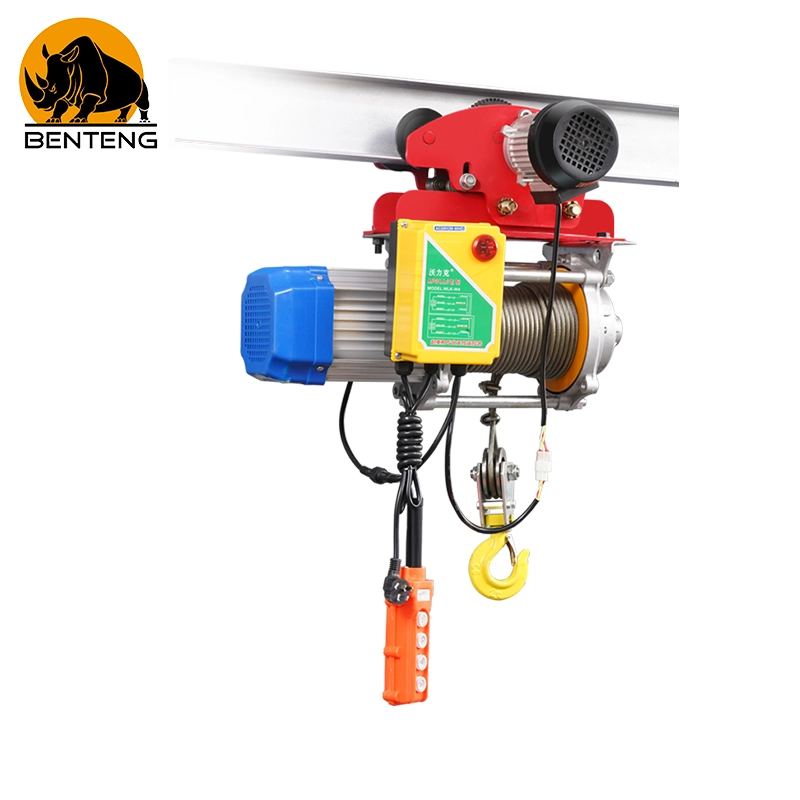
The term electric hoist covers several equipment arrangements. A fixed chain hoist may work well when the lifting point stays in one location. A trolley-mounted hoist can provide horizontal movement along a beam. Other configurations can support more specialized production requirements.
Fixed Electric Hoist vs. Trolley-Mounted Hoist
A fixed electric hoist makes sense when the load only needs vertical movement.
Typical applications include:
- Machine loading
- Die lifting
- Equipment maintenance
- Small assembly stations
- Workbench material handling
A trolley-mounted arrangement becomes useful when the load needs to travel horizontally after lifting.
For example, a fabrication workshop may need to lift a motor from the floor and move it several meters along a beam. A trolley-mounted hoist can combine these movements within one handling system.
This can reduce the need for separate lifting and transfer equipment.
When a Compact Chain Hoist Makes Sense
Chain hoists can suit small manufacturing workshops because many applications involve moderate loads and limited lifting distances.
A compact configuration can also help where installation space is restricted.
For example, the DHC miniature chain electric hoist can be considered for applications where a smaller lifting arrangement fits the workshop’s load and space requirements.
The important point is not simply choosing the smallest available hoist. The equipment still needs sufficient rated capacity, lifting height, duty characteristics, and installation compatibility.
When a Higher-Capacity Hoist Becomes Necessary
A heavy duty electric hoist becomes more relevant when the workshop handles heavier components, longer production cycles, or demanding lifting conditions.
Consider a metalworking shop that regularly handles 2-ton welded frames.
The shop may require:
- Higher rated capacity
- Suitable duty characteristics
- Adequate structural support
- A trolley for horizontal movement
- Controlled lifting and lowering
- Appropriate braking performance
- Regular inspection and maintenance
The capacity should not be selected simply because the workshop wants “more power.” Higher capacity can also affect the supporting structure and overall lifting system.
Consider Future Production
Small workshops often expand production after installing new machinery.
A workshop that currently lifts 700 kg components may begin handling 1-ton assemblies after adding a larger production line.
However, buying excessive capacity today can create unnecessary costs. The decision should therefore balance current requirements with realistic near-term expansion.
A practical question is:
“Will the workshop handle heavier loads within the expected service period of this equipment?”
If the answer is yes, discuss the expected load range with the supplier before selecting the final specification.
3. Match the Hoist to Power Supply, Controls, and Workshop Layout
Electrical and physical compatibility can determine whether a selected hoist works efficiently after installation.
A suitable lifting capacity is not enough. The workshop must also provide the correct electrical supply and installation arrangement.
Check Voltage and Phase
Small workshops do not always have the same electrical infrastructure as large factories.
Before ordering an electric lifting hoist, confirm:
- Available voltage
- Single-phase or three-phase supply
- Frequency
- Available circuit capacity
- Grounding arrangement
- Control voltage requirements
- Cable routing
- Local electrical requirements
For example, a workshop with a 220 V supply may need a hoist designed for that electrical configuration.
The DHS 220V electric chain hoist represents a configuration that can be considered when the workshop’s available supply matches the product specification.
The supplier should receive the actual electrical requirements before production or shipment. This avoids unnecessary modification after delivery.
Consider How the Operator Will Control the Hoist
Control arrangement can affect productivity and operator positioning.
A pendant controller may suit a compact workstation where the operator needs to move with the load.
A remote control may provide greater separation from the lifting area where the application allows it.
Dual control arrangements can also support different production workflows. The Dual operation electric chain hoist can be considered where the application requires more than one operating method.
The control choice should follow the workflow rather than adding features without a practical reason.
Evaluate Horizontal Movement
Ask a simple question:
“After the load leaves the floor, does it need to move sideways?”
If the answer is no, a fixed hoist may be sufficient.
If the answer is yes, evaluate a trolley-mounted system.
For example, a workshop may lift a 500 kg motor from the floor and move it to a maintenance station. A trolley can provide the required horizontal travel.
This arrangement can also reduce manual repositioning and improve workflow consistency.
Check Available Headroom
Headroom often becomes a hidden limitation in small workshops.
Measure the distance from the installation beam to the highest required hook position.
Then consider the physical height of the hoist, hook, trolley, and lifting accessories.
The useful lifting height may be lower than the building’s total ceiling height.
A compact hoist can therefore provide more practical lifting range in a workshop with a low roof.
4. Consider Special Workshop Conditions and Lifting Requirements
Most small manufacturing workshops have fairly straightforward lifting needs. Some environments, however, require specific equipment characteristics.
The surrounding environment should influence the selection from the beginning.
Clean or Corrosive Environments
A workshop handling food-processing equipment, chemicals, or corrosion-sensitive components may need additional attention to material selection.
Moisture and corrosive substances can affect exposed components over time.
A DHK electric chain hoist may be evaluated alongside other configurations according to the required capacity and operating environment.
The final choice should follow the actual environmental conditions and technical specifications rather than relying on product category names alone.
Hazardous Areas Need Separate Evaluation
If the workshop contains flammable gases, vapors, or combustible dust, ordinary lifting equipment may not satisfy the required application conditions.
Hazardous-area equipment may require specific design and certification.
The buyer should identify the hazardous-area classification before selecting the hoist. This information should reach the supplier during the specification stage.
Do not purchase a standard hoist first and attempt to adapt it later for a hazardous environment.
Multiple Lifting Points
Some manufacturing processes require two lifting points.
For example, a long machine frame may need synchronized movement to maintain a level position during lifting.
In such applications, a synchronous lifting electric hoist may be considered when the lifting arrangement requires coordinated movement.
The actual solution depends on load geometry, control requirements, lifting points, and the manufacturer’s technical design.
Lifting Accessories Matter Too
The hoist is only one part of the lifting system.
The complete setup may include:
- Slings
- Shackles
- Hooks
- Clamps
- Lifting beams
- Spreaders
- Custom fixtures
HSE guidance states that lifting equipment must be sufficiently strong, stable, and suitable for the proposed use. It also emphasizes suitable positioning and appropriate marking of safe working loads.
A correctly specified hoist cannot compensate for unsuitable lifting accessories.
For example, a 2-ton hoist does not make a 500 kg-rated sling suitable for a 1-ton load. Every component in the load path needs appropriate capacity and compatibility.
5. Compare Hoist Options Before Making the Purchase
After defining the application, create a technical comparison rather than comparing price alone.
A simple procurement table can help production, engineering, and purchasing teams reach the same decision.
Electric Hoist Selection Matrix
| Selection factor | Questions for the workshop | Why it matters |
|---|---|---|
| Rated capacity | What is the heaviest intended load? | Determines required lifting capacity |
| Working load | What load appears most often? | Helps define normal operating conditions |
| Lifting height | How far must the load rise? | Determines useful lifting travel |
| Duty cycle | How often will the hoist operate? | Influences motor and component requirements |
| Power supply | What voltage and phase are available? | Ensures electrical compatibility |
| Movement | Does the load need horizontal travel? | Determines fixed or trolley configuration |
| Headroom | How much vertical space is available? | Influences hoist and trolley selection |
| Environment | Is the area dusty, wet, corrosive, or hazardous? | May require specialized configuration |
| Control | Where will the operator stand? | Influences pendant or remote operation |
| Future demand | Will load weight or frequency increase? | Helps avoid premature replacement |
| Maintenance | Who will inspect and service the unit? | Supports long-term operating control |
This comparison can also help purchasing teams communicate with suppliers.
Instead of asking for “a 1-ton electric hoist,” provide the complete application.
For example:
“Required capacity: 1 ton. Typical load: 700 kg. Lifting height: 5 m. Operation: 40 cycles per day. Power: 220 V. Horizontal movement: required. Installation: overhead beam. Environment: indoor metalworking workshop.”
That specification gives the supplier enough information to recommend a configuration based on the actual application.
Example: Choosing a Hoist for a Small Machinery Workshop
Imagine a machinery workshop with six production workers.
The workshop needs to move machine components weighing up to 800 kg. Most components weigh between 400 kg and 650 kg. The lifting height is 3.5 m.
The load moves from a storage area to an assembly station. Horizontal movement is therefore necessary.
The hoist operates around 30 lifting cycles per day. The workshop has a suitable overhead beam and a 220 V electrical supply.
Based on these conditions, the selection process should focus on:
- Capacity suitable for the maximum planned load
- A trolley arrangement
- 220 V electrical compatibility
- Adequate lifting height
- A duty specification suitable for the operating frequency
- Operator controls that match the workflow
- Suitable structural and electrical installation
The workshop should then compare available models against these requirements.
This approach is more useful than starting with a model number because it keeps the equipment selection connected to production needs.
Avoid Selecting by Capacity Alone
A common procurement mistake is to compare hoists using only rated capacity and price.
Two 1-ton hoists may have different:
- Lifting speeds
- Motor configurations
- Duty characteristics
- Control systems
- Mounting dimensions
- Trolley options
- Lifting heights
- Electrical requirements
- Maintenance requirements
Capacity is therefore the starting point, not the complete specification.
For B2B procurement, the equipment should also fit the workshop’s operating process and maintenance capability.
Contact Benteng to discuss an electric hoist configuration for your workshop application.
6. Check Safety, Maintenance, and Total Operating Requirements
A hoist selection decision should continue beyond the purchase order.
The workshop also needs a practical plan for installation, inspection, operator training, and maintenance.
Verify Installation Requirements
Before installation, confirm that the supporting structure can handle the intended equipment and load.
The installation area should provide adequate clearance and access.
The equipment should also remain accessible for inspection and maintenance.
ASME B30.16 specifically addresses installation, inspection, testing, maintenance, and operation for overhead underhung and stationary hoists.
If the workshop modifies an existing lifting structure, qualified engineering review may be required.
OSHA also requires new and altered cranes to undergo initial inspection and operational testing before use.
Plan Routine Inspection
A small workshop should not treat the hoist as maintenance-free equipment.
Inspection requirements depend on the equipment, operating environment, service intensity, and applicable regulations.
OSHA classifies overhead crane inspections into frequent and periodic categories. Frequent inspections can range from daily to monthly intervals, while periodic inspections can range from one to twelve months.
The workshop should maintain records that identify the equipment and document relevant inspection findings.
Train Operators
A motorized hoist should only be operated by people who understand its controls and operating limitations.
Training should cover:
- Rated capacity
- Load attachment
- Control operation
- Emergency procedures
- Load positioning
- Pre-use inspection
- Prohibited lifting practices
- Reporting of defects
Operators should never use the hoist to compensate for poor rigging or an unsuitable lifting point.
HSE guidance states that lifting operations should be planned, supervised, and carried out safely by competent people.
Consider the Total Cost
Purchase price represents only one part of the equipment cost.
A B2B buyer should also consider:
- Installation
- Electrical work
- Supporting structure
- Trolley or mounting equipment
- Lifting accessories
- Inspection
- Maintenance
- Replacement components
- Operator training
- Downtime during service
A low-cost hoist that does not match the application can create additional costs later.
A correctly specified industrial electric hoist can provide a more predictable production workflow when its capacity, duty, installation, and maintenance requirements match the workshop.
FAQ
What size electric hoist does a small manufacturing workshop need?
There is no single capacity for all small workshops. Start with the maximum intended load, typical working load, lifting height, operating frequency, and movement requirements. Then select a suitable capacity and configuration.
Is a 1-ton electric hoist suitable for a small workshop?
It can be suitable when the workshop’s maximum intended load, lifting frequency, structure, and installation conditions match the hoist specification. A 1-ton rating alone does not determine whether the equipment fits the application.
Should I choose a chain hoist or wire rope hoist?
Chain hoists can suit many compact workshop applications with moderate lifting requirements. Wire rope hoists may suit different load capacities, lifting heights, and duty conditions. The decision should follow the actual application rather than the workshop size.
Do I need a trolley for my electric hoist?
You need to evaluate whether the load must move horizontally after lifting. A fixed hoist can suit a stationary lifting point. A trolley becomes useful when the load needs controlled movement along a beam.
What voltage should I choose for an electric hoist?
Choose the voltage that matches the workshop’s available electrical supply and the hoist’s rated electrical requirements. Common configurations vary by market and application. Confirm voltage, phase, and frequency before ordering.
How much lifting height should I specify?
Measure the required vertical movement from the lowest load position to the highest working position. Then consider headroom, hoist dimensions, hook position, trolley height, and lifting accessories.
Is a heavy duty electric hoist necessary for a small workshop?
Not necessarily. Workshop size does not determine the required hoist duty. Load frequency, operating cycle, load weight, and working environment are more useful selection factors.
Can I use the same hoist for different production areas?
You can consider this when the loads, lifting points, capacity, travel path, and operating conditions are compatible. The complete lifting system must remain within its rated limits.
What information should I send to an electric hoist supplier?
Provide the maximum load, typical load, lifting height, lifting frequency, power supply, installation method, horizontal travel requirements, operating environment, and control preference. Photos or drawings of the installation area can also help suppliers evaluate the application.
What standards should I check before purchasing?
The applicable standards depend on the country, equipment type, and workplace. ASME B30.16 covers overhead underhung and stationary hoists. OSHA provides requirements for relevant U.S. workplaces. In the UK, LOLER establishes requirements for lifting equipment used at work.
Benteng Electric Hoists for Workshop Lifting Applications
Benteng supplies electric hoist solutions for manufacturing and industrial lifting applications. The selection process should begin with the customer’s actual load, lifting height, operating frequency, power supply, installation arrangement, and working environment. Benteng can support different requirements through electric chain hoist configurations and application-specific lifting solutions. For small manufacturing workshops, the objective should be a hoist that fits the production process without unnecessary capacity or features. A clear technical specification also helps align equipment selection, installation, operation, and maintenance from the beginning.
References
- Occupational Safety and Health Administration (OSHA), 29 CFR 1910.179, Overhead and Gantry Cranes: https://www.osha.gov/laws-regs/regulations/standardnumber/1910/1910.179
- ASME, B30.16, Overhead Underhung and Stationary Hoists: https://www.asme.org/codes-standards/find-codes-standards/overhead-underhung-and-stationary-hoists
- Health and Safety Executive (HSE), Lifting Equipment at Work: https://www.hse.gov.uk/pubns/indg474.pdf
- Health and Safety Executive (HSE), Safe Use of Lifting Equipment and LOLER: https://www.hse.gov.uk/pubns/priced/l113.pdf