
How Can You Use an Electric Chain Hoist Safely and Correctly in Industrial Applications?
October 2, 2026
Using an electric chain hoist correctly requires more than pressing the lifting button. Operators must match the hoist to the load, inspect the equipment, connect the load correctly, control movement, and follow the manufacturer’s operating limits. The basic sequence starts with a pre-use inspection, continues with proper rigging and controlled lifting, and ends with safe lowering and shutdown. For factories and industrial buyers, correct operation also depends on rated capacity, lifting height, duty cycle, installation method, working environment, and operator training.
An electric chain hoist can handle repetitive lifting with less manual effort than a hand-operated hoist. However, powered lifting also introduces faster movement and greater mechanical force. Poor load attachment, side pulling, overload, damaged chains, or incorrect controls can create serious hazards.
The same principle applies whether the equipment is a compact workshop hoist or a heavy duty chain hoist for production handling. The operator must understand the equipment’s rated capacity and operating limits before starting work.
For example, a factory may use a motorized chain hoist to move a 500 kg machine component between assembly stations. The operator should first inspect the chain and hook, confirm the load weight, position the hook above the load, attach an approved lifting device, and perform a controlled test lift. Only after confirming balance and clearance should the operator continue the lift.
This guide explains how to use an electric hoist from preparation through shutdown. It also covers load attachment, lifting techniques, trolley operation, working environments, inspection, maintenance, and common operating mistakes.
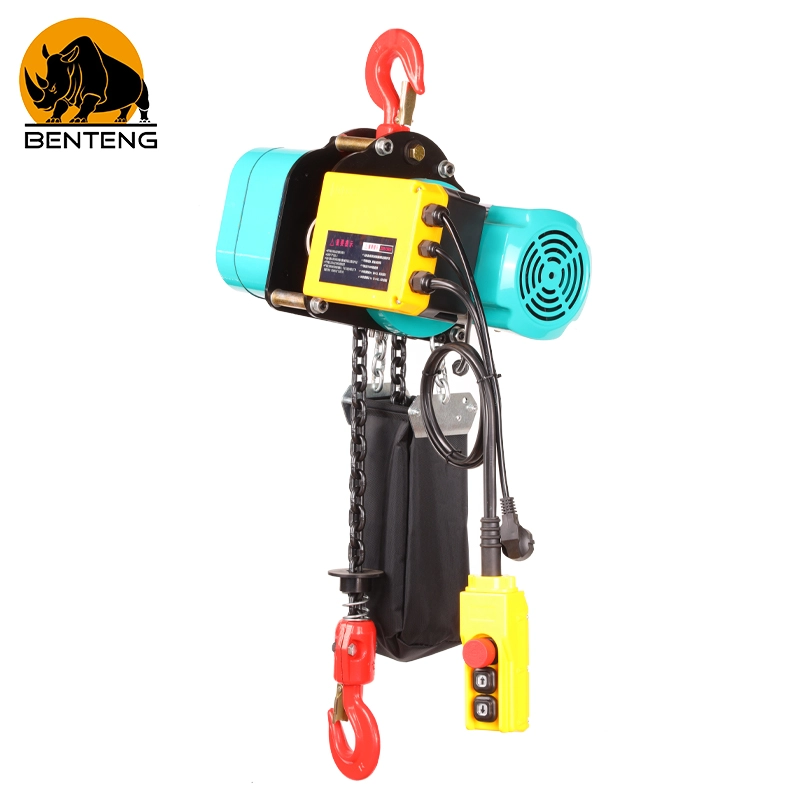
What Should You Check Before Using an Electric Chain Hoist?
The safest lifting operation starts before the motor runs. Operators should inspect the equipment and work area before connecting a load.
A pre-use check helps identify problems that could affect lifting control. It also gives operators an opportunity to verify that the selected hoist matches the planned task.
Check the Rated Capacity
Every electric chain hoist has a rated lifting capacity. The load must remain within that rating.
Do not estimate the load weight when accurate information is available. Check the equipment nameplate, load documentation, machine specifications, or other reliable records.
The total lifting load may include the product, fixture, sling, hook accessories, spreader beam, or other attached equipment.
For example, a 1,000 kg machine part may require a lifting arrangement that adds another 50 kg. The operator should consider the complete suspended load when evaluating the lifting capacity.
OSHA’s overhead crane requirements state that equipment must not exceed its rated load except for permitted testing. The rules also require rated-load markings to remain clearly legible. (OSHA)
Inspect the Load Chain
The chain carries the lifting force between the hoist mechanism and the hook.
Before operation, check for visible problems such as:
- Twisted links
- Distorted links
- Excessive wear
- Corrosion
- Cracks
- Damaged end connections
- Abnormal chain movement
The chain should move through the hoist smoothly. Do not operate the equipment if the chain shows damage that could affect safe operation.
OSHA specifically identifies hoist chains as inspection items and calls for attention to excessive wear, twisted or distorted links, and stretch beyond manufacturer recommendations.
Inspect the Hook
The hook connects the hoist to the lifting arrangement.
Check the hook for cracks, deformation, excessive throat opening, twisting, and other visible damage. Also inspect the safety latch if the hook includes one.
The hook should sit correctly within the lifting attachment. Never position a load on the tip of the hook.
A properly positioned connection allows the load force to transfer through the intended hook section.
Check the Brake and Controls
Test the control system according to the manufacturer’s instructions.
The up and down functions should respond correctly. The emergency stop should function as intended where provided.
Operators should also check the brake response before handling a significant load.
OSHA requires holding brakes for independent hoisting units in covered crane applications. Its rules also include requirements for control systems and electrical equipment.
Inspect the Work Area
The lifting path should remain clear.
Look for:
- People within the lifting area
- Overhead obstructions
- Machinery
- Pipes and cables
- Structural interference
- Uneven or unstable load positions
- Other lifting equipment
A clear path gives the operator better control and reduces the chance of collision.
The operator should also identify where the load will be placed before starting the lift.
Confirm the Supporting Structure
The hoist needs a suitable supporting point, beam, trolley, monorail, or crane system.
Do not assume that a beam can support the hoist simply because it appears structurally strong.
The supporting structure must accommodate the hoist, the suspended load, and the dynamic forces associated with lifting and movement.
This factor becomes especially important when installing an industrial chain hoist as part of a permanent material handling system.
How Should You Attach and Lift a Load With an Electric Hoist?
Once the equipment passes the pre-use check, the next step involves attaching the load correctly.
Good rigging practice determines how the lifting force transfers from the hook to the load.
Position the Hook Above the Load
The hook should sit directly above the load’s intended lifting point.
This position helps keep the lifting force vertical.
Avoid pulling the hook sideways to reach a load. Side pulling can introduce forces that the hoist and supporting structure were not designed to handle.
For example, assume a 600 kg steel component sits two meters away from the hoist’s vertical lifting position. Moving the hook sideways while applying lifting force can create an unstable loading condition.
The safer approach is to reposition the lifting equipment or use a suitable travel system.
Select Suitable Lifting Accessories
The hoist hook does not normally connect directly to every type of load.
Depending on the application, operators may use:
- Chain slings
- Wire rope slings
- Web slings
- Shackles
- Lifting beams
- Rated lifting clamps
- Engineered fixtures
Each accessory must have a suitable working load limit for the intended application.
Inspect lifting accessories before use. Damaged or unsuitable equipment should not enter the lifting arrangement.
Keep the Load Balanced
The load should remain stable during lifting.
Identify the center of gravity before raising the load. Uneven weight distribution can cause the load to tilt or rotate.
A test lift of only a few centimeters can reveal balance problems before the load reaches a significant height.
For example, a motor may look symmetrical but contain a heavier gearbox on one side. A single central lifting point could cause the motor to tilt during the first stage of lifting.
The operator should stop and correct the rigging arrangement rather than trying to control the imbalance through the pendant.
Take Up the Slack Gradually
Do not start a lift with sudden acceleration.
First remove slack from the lifting accessories. Then raise the load slowly until the lifting system becomes fully tensioned.
Pause briefly and check the load position.
This method allows the operator to identify slipping, uneven loading, or rigging problems before continuing.
Perform a Controlled Test Lift
Raise the load only a short distance at first.
Check:
- Load balance
- Hook position
- Sling position
- Chain movement
- Brake response
- Structural stability
- Clearance
If the load remains stable, continue the lifting operation.
If the load shifts unexpectedly, lower it carefully and correct the problem.
OSHA guidance for covered crane operations emphasizes securing and balancing the load before lifting it more than a few inches. It also addresses avoiding sudden acceleration and deceleration.
Continue at a Controlled Speed
Once the test lift confirms stability, continue the lift smoothly.
Avoid rapid starts and stops unless the equipment design specifically supports that operating mode.
Smooth control reduces swinging and unnecessary mechanical stress.
The operator should maintain visibility of the load whenever possible.
How Do You Use Different Electric Hoist Configurations?
Not every electric hoist operates in the same installation environment.
The basic lifting procedure remains similar, but the operator’s responsibilities change according to the equipment configuration.
Fixed Electric Chain Hoist
A fixed hoist remains attached to a stationary suspension point.
This configuration suits applications where loads move vertically within a defined work area.
Examples include:
- Machine maintenance
- Mold handling
- Workshop lifting
- Equipment installation
- Assembly operations
The operator focuses mainly on vertical movement and load positioning.
Electric Chain Hoist With Trolley
A trolley adds horizontal movement along a compatible beam or monorail.
An electric chain hoist with trolley can therefore support lifting and transfer between nearby workstations.
The operator must control two types of movement.
First, the hoist raises or lowers the load. Second, the trolley moves the suspended load horizontally.
The operator should raise the load only as high as necessary for the planned travel path.
Keeping unnecessary lifting height to a minimum can reduce the potential travel distance if the load becomes unstable.
Low Headroom Installation
Some factories have limited vertical space between the supporting structure and the floor.
In these applications, the distance between the suspension point and hook can become a major design consideration.
A low headroom electric chain hoist can suit installations where available headroom requires a compact lifting arrangement.
Operators should still follow the model-specific lifting height and installation instructions.
Low headroom equipment does not remove the need for adequate clearance.
Hook Suspension Configuration
A hook suspension hoist attaches directly to a suitable suspension point.
A European hook suspension hoist may suit applications that use compatible structural or lifting arrangements.
The operator should verify the suspension point before loading the hoist.
The hook or suspension component must engage correctly and remain stable during operation.
Specialized Working Environments
Standard equipment should not automatically enter every industrial environment.
Temperature, moisture, dust, chemicals, corrosive substances, and hazardous atmospheres can affect equipment selection.
For corrosive or hygiene-sensitive applications, a Stainless Steel Electric Hoist may be considered where its specification matches the application.
Hazardous areas require additional attention to electrical and mechanical design.
Where the work environment contains potentially explosive atmospheres, an Explosion-proof Electric Chain Hoist may be appropriate for the applicable area classification.
The site classification should guide equipment selection. Operators should never assume that a standard hoist has explosion-protection characteristics.
How Should Operators Move and Position Loads?
Lifting the load is only one part of the operation.
The operator must also control acceleration, travel, positioning, and lowering.
Avoid Side Pulling
The hook should remain aligned with the load.
Side pulling can create forces that differ from the intended vertical lifting direction.
It can also cause the load to swing toward the operator or nearby equipment.
If the load is not directly below the hoist, reposition the lifting system before lifting.
Avoid Sudden Acceleration
Sudden movement can make a suspended load swing.
The longer the load hangs below the hoist, the more noticeable the swing can become.
A swinging load may strike machinery, structures, storage racks, or people.
Controlled movement gives the operator more time to respond.
Keep People Away From Suspended Loads
People should not stand beneath suspended loads.
The operator should also prevent unauthorized personnel from entering the lifting area.
This requirement becomes especially important when moving heavy components through production facilities.
OSHA’s crane requirements state that operators should avoid carrying loads over people. They also require attention to proper load attachment and balanced movement.
Use the Trolley Correctly
When a trolley system moves the hoist horizontally, the load should remain controlled.
Avoid dragging loads along the floor.
The lifting hook should remain vertically aligned with the load during the movement.
If the load begins to swing, stop and allow it to stabilize before continuing.
Position the Load Slowly
As the load approaches its destination, reduce movement speed where possible.
Small positioning errors become more difficult to correct at higher speed.
The operator should also confirm that the destination area can support the load.
For machinery installation, this may involve alignment with mounting holes or foundation points.
For warehouse handling, it may involve positioning the load onto a pallet, rack, or fixture.
How Should an Electric Chain Hoist Be Used in Different Industrial Applications?
Operating conditions change significantly between industries.
A hoist used for machine maintenance does not necessarily face the same duty cycle as a hoist used in a production line.
Manufacturing Facilities
Manufacturing plants often use electric hoists to move dies, molds, motors, gearboxes, steel components, and production tooling.
Repeated lifting requires attention to duty cycle and operator consistency.
For example, a stamping facility may use a hoist to change heavy dies between production runs.
The operator may need precise positioning rather than maximum lifting speed.
Machinery Maintenance
Maintenance departments often use hoists intermittently.
A typical task may involve removing a motor, pump, gearbox, or machine assembly.
The equipment may remain unused for several days before another lifting task occurs.
Inspection becomes particularly important after extended periods without use.
The operator should confirm equipment condition before returning the hoist to service.
Warehouses and Material Handling
Warehouses may use electric chain hoists for handling machinery parts, packaged components, or heavy maintenance equipment.
A trolley configuration can help transfer loads along a defined path.
The operator should ensure that the travel route remains clear.
Storage racks and suspended loads should maintain suitable clearance.
Steel and Fabrication Workshops
Steel components can create high point loads and awkward lifting conditions.
The operator must understand the component’s center of gravity before lifting.
Long materials may also require additional lifting points or engineered fixtures.
A single hook connection may not provide adequate stability for every shape.
Shipyards and Heavy Equipment Facilities
Shipyard applications can involve large components and complex working areas.
The lifting path may change as construction progresses.
Environmental exposure may also influence equipment selection.
Operators should follow site-specific lifting procedures and equipment limitations.
Table 1. Electric Hoist Operating Considerations by Application
| Application | Typical lifting task | Main operating consideration |
|---|---|---|
| Manufacturing | Dies, molds, motors, tooling | Duty cycle and positioning |
| Maintenance | Pumps, gearboxes, machine parts | Inspection and controlled lifting |
| Warehouse | Components and equipment | Travel path and clearance |
| Steel fabrication | Frames and steel parts | Center of gravity and rigging |
| Shipyard | Heavy assemblies | Site conditions and lifting path |
| Assembly line | Repetitive components | Cycle frequency and control |
| Machinery installation | Motors and modules | Precise positioning |
The table illustrates why a single hoist specification cannot cover every operating situation.
Procurement teams should define the application before selecting the equipment configuration.
What Are the Most Common Mistakes When Using an Electric Hoist?
Many lifting problems come from incorrect operation rather than equipment complexity.
The following mistakes deserve particular attention during operator training.
Overloading the Hoist
Overloading occurs when the suspended load exceeds the rated capacity.
It can also occur when operators underestimate the total load by ignoring lifting accessories.
Always verify the complete lifting weight before operation.
Pulling Loads Sideways
Side pulling changes the direction of force.
The hoist may not be designed for that loading condition.
Position the hoist above the load before lifting.
Using a Damaged Chain
Operators should not continue using a chain that shows obvious damage.
The chain is a critical load-bearing component.
Inspection should follow the manufacturer’s requirements and applicable regulations.
Using the Limit Switch as a Normal Stop
A limit switch serves a protective function.
It should not replace normal operator control.
OSHA specifically states that the hoist upper limit switch should not serve as an operating control.
Operators should stop the hoist using the normal control system before reaching the limit.
Lifting People With Standard Equipment
A standard material-handling hoist should not automatically be treated as personnel lifting equipment.
Personnel lifting requires equipment, procedures, and approvals designed for that purpose.
Never place a person on a suspended load or use the load hook as an improvised personnel platform.
Leaving a Suspended Load Unattended
A suspended load creates a continuing hazard.
Operators should follow site procedures for suspended loads and should not leave the control position when the applicable rules prohibit doing so.
The safest practice is to lower the load to a suitable resting position whenever the task permits.
Ignoring Abnormal Noise
Unusual noise, vibration, jerking, or irregular chain movement can indicate a mechanical or electrical problem.
Do not treat new operating sounds as normal without checking the equipment.
Stopping early can prevent a minor issue from developing into a larger maintenance problem.
How Should You Maintain an Electric Chain Hoist After Use?
Correct operation continues after the load reaches the floor.
Operators and maintenance teams should follow the manufacturer’s inspection and maintenance instructions.
Lower the Load Completely
Where practical, lower the load to a stable resting position after completing the task.
Do not leave a load suspended simply because the next lifting cycle will occur later.
Store the Pendant Correctly
The pendant should remain clean and protected from impact.
Do not allow the control cable to become trapped beneath equipment or tangled around structural components.
Control labels should remain visible.
Inspect the Chain After Operation
Look for changes that appeared during the lifting cycle.
Check for:
- New deformation
- Abnormal wear
- Corrosion
- Lubrication issues
- Chain accumulation problems
- Unusual movement
The inspection process should follow the manufacturer’s instructions.
Record Maintenance Issues
Industrial facilities should document significant defects and maintenance actions.
Records can help maintenance teams identify recurring problems.
They also provide useful information when evaluating replacement parts or planning equipment upgrades.
Follow the Inspection Schedule
Inspection frequency depends on the equipment, operating environment, duty cycle, and applicable regulations.
ISO 9927-1 establishes general inspection requirements for cranes. The standard covers inspection requirements and methods, while specific crane types may have additional requirements. (ISO)
In the United Kingdom, the HSE’s LOLER guidance addresses safe use and examination of lifting equipment. It emphasizes suitable equipment, competent personnel, and appropriate lifting operations. (HSE)
The exact inspection schedule should follow the applicable local requirements and the manufacturer’s instructions.
How Can Buyers Train Operators to Use an Electric Chain Hoist?
A good operating procedure should be simple enough for operators to follow consistently.
Training should cover both normal operation and abnormal situations.
Basic Operator Training
Operators should understand:
- Rated capacity
- Control functions
- Hook and chain inspection
- Load attachment
- Test lifting
- Load positioning
- Emergency procedures
- Shutdown procedures
- Defect reporting
The operator should also understand when to stop the operation.
Use Application-Specific Procedures
A factory should avoid relying only on generic lifting instructions.
For example, die changes may require a different procedure from motor removal.
Production areas may also require defined travel paths.
Maintenance teams should identify the lifting points for frequently handled equipment.
Make Stop Conditions Clear
Operators should know which conditions require immediate shutdown.
Examples include:
- Damaged chain
- Deformed hook
- Brake malfunction
- Unexpected load movement
- Abnormal electrical behavior
- Control failure
- Excessive noise
- Contact with an obstruction
- Unstable supporting structure
A clear stop procedure helps prevent operators from attempting to correct equipment problems while the load remains suspended.
Keep Training Records
Industrial facilities should document operator training according to their internal procedures and applicable requirements.
Records can identify who has completed training and which equipment they are authorized to operate.
For larger factories, this also helps standardize operating practices between shifts.
FAQ: Using an Electric Chain Hoist
Can one person operate an electric chain hoist?
Many electric hoists use pendant controls designed for floor operation.
However, the number of people involved depends on the lifting task.
The operator may need assistance with rigging, load positioning, signaling, or clearance.
The lifting plan should define responsibilities before the operation starts.
Can I use an electric chain hoist for continuous lifting?
That depends on the hoist’s rated duty classification and the application.
Continuous or frequent lifting creates more thermal and mechanical demand.
Check the manufacturer’s duty rating, operating cycle, motor specifications, and applicable standards.
Do not assume that a higher-capacity hoist automatically supports continuous operation.
How high should I lift the load?
Lift only as high as necessary for the task.
Excessive lifting height increases the potential travel distance and can complicate load control.
For trolley applications, raise the load enough to clear obstacles while maintaining practical control.
Can I pull a load sideways with an electric chain block?
Do not use side pulling unless the equipment manufacturer specifically permits that application.
A standard electric chain block is generally intended for controlled lifting in its designed direction.
Reposition the hoist or use an appropriate travel system instead.
What should I do if the load starts swinging?
Stop the movement and allow the load to stabilize.
Do not attempt to control a large swinging load by standing close to it.
Identify the reason for the swing before continuing.
The cause may involve sudden acceleration, an off-center load, an unsuitable lifting point, or horizontal movement.
Should I test lift every load?
A controlled test lift helps confirm that the load is balanced and properly attached.
The exact procedure should follow the site’s lifting plan and equipment instructions.
For unfamiliar or irregular loads, a short test lift is particularly useful.
How often should the chain be inspected?
Inspection frequency depends on the manufacturer’s requirements, operating conditions, and applicable regulations.
Operators should perform the checks required before use.
More detailed inspections should follow the applicable inspection schedule.
OSHA’s covered crane requirements specify frequent and periodic inspection categories, including checks of hoist chains, hooks, mechanisms, brakes, and electrical components.
Can an electric chain hoist be installed on any beam?
No.
The supporting structure must have adequate capacity and suitable dimensions.
Trolley wheels, suspension points, beam flanges, and travel arrangements must also match the hoist configuration.
A qualified engineer or responsible technical person should evaluate the supporting structure where required.
What is the difference between an electric hoist and an electric chain hoist?
Electric hoist is a broad product term.
Electric chain hoists use a load chain as the lifting medium.
Electric wire rope hoists use wire rope and a drum instead.
The correct choice depends on load capacity, lifting height, duty cycle, installation space, and application requirements.
What information should I give an electric chain hoist supplier?
Provide the load capacity, lifting height, lifting speed, duty cycle, power supply, installation method, working environment, and required controls.
For trolley systems, provide beam information and required travel distance.
Photos, drawings, and application descriptions can also help suppliers evaluate the installation.
References
Occupational Safety and Health Administration, 29 CFR 1910.179, Overhead and Gantry Cranes
ISO 9927-1:2013, Cranes — Inspections — Part 1: General
Health and Safety Executive, Safe Use of Lifting Equipment, LOLER Guidance
Health and Safety Executive, Lifting Operations and Lifting Equipment Regulations
International Organization for Standardization
Benteng is an electric chain hoist supplier serving industrial lifting and material handling applications. Its product range includes electric chain hoists for fixed, trolley-mounted, low-headroom, and specialized operating environments. Benteng works with distributors, machinery manufacturers, factories, and industrial buyers that need equipment matched to load capacity, lifting height, duty cycle, installation conditions, and power requirements. Its technical approach focuses on selecting the appropriate hoist configuration for the actual lifting application.